
The short version
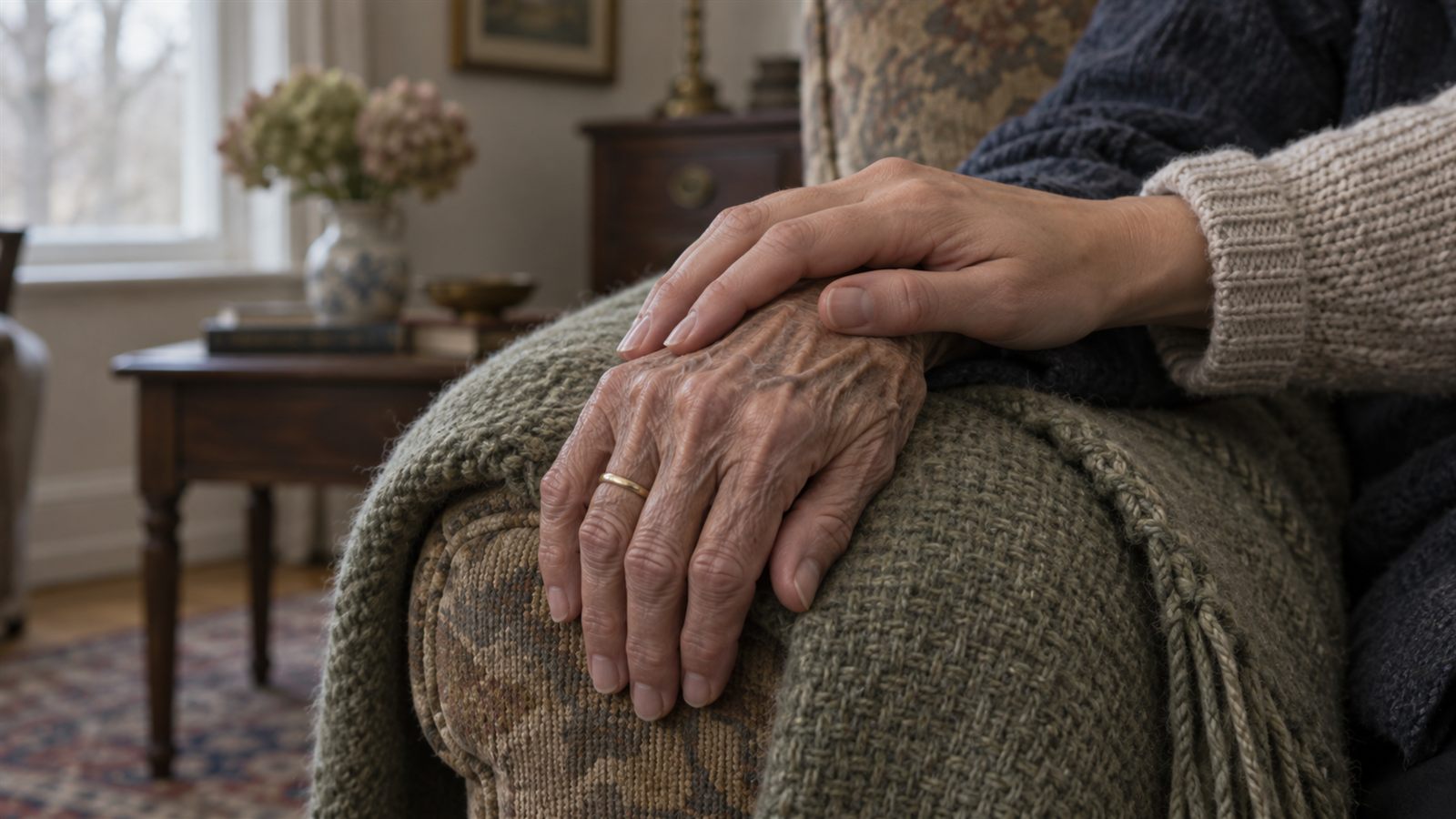
Anticipatory grief is the grief that starts before the loss does. It happens when someone you love has a terminal diagnosis, or dementia, or is simply declining in a way that has only one direction. You are mourning a person who is still in the next room, which is confusing enough on its own, and it often comes with guilt for grieving someone who hasn't died. It's a recognized and ordinary response to an extended loss. It is not disloyalty, and it doesn't mean you've given up on them.
Grieving in the present tense
Most of what gets written about grief assumes a clear before and after. Someone dies, and then you grieve. Anticipatory grief doesn't work that way. You're managing medication schedules and insurance calls and a person who needs you today, while some part of you is already living in the version of the world where they're gone.
That split is the hardest part to explain to anyone who hasn't been in it. You can be fully present at a Sunday dinner and simultaneously aware you're counting them. People notice you seem off and you can't tell them why, because saying it out loud sounds like you're rushing your mother out of the world.
You aren't. Your mind is doing something it does under a long, unresolvable strain, which is to rehearse.
What it tends to look like
Anticipatory grief rarely looks like sadness alone. More often it's a mix that doesn't feel like it should belong together:
- Waves of sorrow that arrive during something completely routine, like the drive home from a normal visit.
- Irritability with the person you're losing, sometimes over small things, followed immediately by shame about it.
- A kind of pre-emptive distance, where you catch yourself pulling back to make the eventual loss smaller. It doesn't work, but the instinct is common.
- Exhaustion that sleep doesn't touch, because the vigilance never fully switches off.
- Relief mixed in, especially with a long illness or dementia, and then real distress about having felt relief at all.
- Difficulty planning anything, since the calendar has an open-ended hole in it that you can't schedule around.
Dementia adds a particular version of this. The loss arrives in installments rather than all at once. People describe grieving their father repeatedly, as each part of him goes, while he's sitting across the table.
Why New Jersey families are carrying a lot of this quietly

This is not a rare experience here. AARP's Caregiving in the U.S. 2025 report found that 26 percent of New Jersey adults, close to two million people, are family caregivers. Twenty-one percent of them provide forty hours a week or more. Forty-seven percent have been doing it for three years or longer, and about three quarters are holding down a job at the same time.
Those numbers describe a lot of people in Essex County running a second full-time job that nobody sees, on top of the first one. Anticipatory grief is the emotional weather of that job, and it is almost always carried privately, because the culture has a script for bereavement and no script at all for this.
The guilt part
Nearly everyone I work with on this brings guilt, and it usually takes one of a few forms.
Guilt for grieving early, as though feeling it now takes something from the person while they're alive. Guilt for the flashes of resentment, which are a normal response to sustained demand and not a referendum on how much you love someone. Guilt for the thought that arrives uninvited at 2 a.m., the one about how it would be a mercy if this ended. That thought horrifies people. It's also extremely common among caregivers watching prolonged suffering, and it coexists perfectly well with love.
Guilt tends to lose some of its grip once it's said out loud to someone who doesn't flinch. That's a large part of what the work is.
Does grieving now make it easier later?
Partly, and less than people hope.
There's some truth to the idea that anticipatory grief does a portion of the work in advance. Families often describe the practical aftermath as less disorienting, because decisions were thought through rather than made in the first shocked week.
The idea that it means you'll be fine afterward is not true, and I want to be careful here, because people set themselves up with that expectation and then feel broken when the death lands hard anyway. It usually does. Preparing for a loss is not the same as absorbing one, and grief after a long illness has its own particular shape, including the sudden emptiness where the caregiving used to be. Grief after an expected death also refuses to follow a schedule, which is covered in more detail in this piece on grief not following a timeline.
What helps while you're still in it
Nothing here fixes the situation. These are the things that seem to make it more survivable.
Name it accurately, at least to yourself. A lot of the disorientation comes from experiencing grief while telling yourself you have no right to grieve yet. Calling it what it is removes one layer.
Protect something that's yours. Caregiving expands to fill whatever space it's given. One evening a week that belongs to you is not a luxury, and it's usually the first thing to disappear.
Say the things now. People deep in the logistics of illness often postpone the actual conversations, assuming there will be a better moment. There frequently isn't. Whatever you'd want them to have heard, the time for it is while they can still hear it.
Let the good days be good. Anticipatory grief can steal the remaining time by keeping you braced. Some days will be genuinely good ones, and you're allowed to be in them.
Find one person who can hear it without managing you. That might be a sibling, a friend who has done this, a support group at the hospital or hospice, or a therapist. What matters is that you can say the ugly parts and not have them corrected.
When it's worth getting help with
Consider talking to someone if you can't sleep even when you have the opportunity, if you're withdrawing from people who want to help, if you're leaning on alcohol to get through evenings, if resentment is starting to affect how you treat the person you're caring for, or if you simply cannot keep functioning at the level the situation demands.
If you reach a point where you don't want to be here anymore, call or text 988 for the Suicide and Crisis Lifeline.
If you want to talk

I'm Daniel Erbach, a Licensed Clinical Social Worker with more than twenty years of experience in New Jersey, across nonprofit, agency, and private practice settings. Alongside grief work I see people for individual counseling more broadly. A good deal of my grief counseling work is with people in exactly this position: still in it, still functioning, with nowhere to put any of it.
The office is at 28 Valley Rd, Suite 1 in Montclair, and I see clients throughout Essex County, including Bloomfield, West Orange, Cedar Grove, and Newark. Telehealth covers all of New Jersey, which matters when your week is already built around someone else's appointments.
I offer a free fifteen-minute consultation. Call (862) 346-1789. You don't need to have the words ready before you call.
Schedule a free consultation →
Daniel Erbach, LCSW, is a licensed psychotherapist in Montclair, New Jersey with more than twenty years of experience working with adults through loss, caregiving, and change. Any examples here are composites and describe no individual client. This article is general information, not clinical advice, and does not create a therapeutic relationship.